
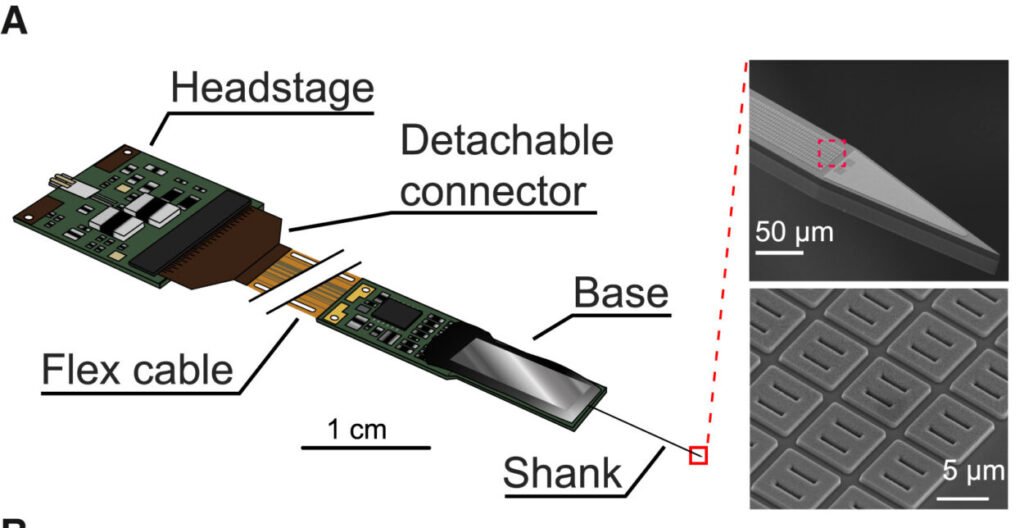
Understanding how the brain works during real-life behavior has long been a challenge for neuroscientists. Researchers at the University of Washington have developed a powerful new neural probe that records activity across multiple brain regions while animals are freely moving. This tool allows scientists to observe how different circuits interact during tasks like decision-making, movement, and social interaction.
The probe is made from ultra-thin, flexible materials that minimize damage to brain tissue and allow for long-term recordings. It contains hundreds of electrodes arranged to capture signals from deep and surface-level structures simultaneously. In tests with mice, the device recorded detailed patterns of neural activity as the animals explored their environment and responded to stimuli.
One of the major breakthroughs is the probe’s ability to maintain stable recordings over time. Traditional devices often lose signal quality or cause inflammation, but the UW probe remains functional for weeks, providing consistent data. This opens the door to studying learning, memory, and behavioral changes over extended periods.
The researchers also developed custom software to analyze the massive datasets generated by the probe. This includes tools for identifying neural ensembles, tracking signal flow between regions, and linking brain activity to specific behaviors. The system is designed to be scalable, allowing future versions to include even more electrodes and support more complex experiments.
This technology could accelerate research into neurological disorders such as autism, schizophrenia, and Alzheimer’s disease by revealing how brain networks malfunction during behavior. It may also support the development of brain-computer interfaces and neuroprosthetics by providing a clearer map of how thoughts and actions are encoded.
