
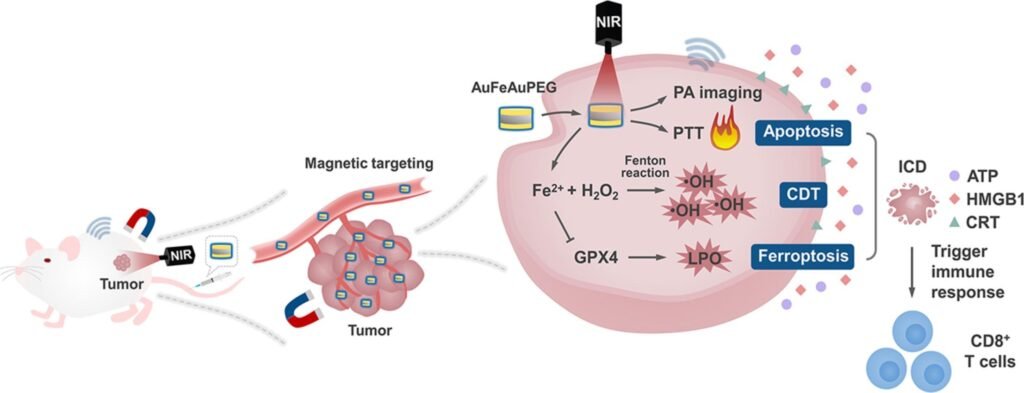
Cancer treatment has long been a balancing act—target the tumor without harming healthy tissue, deliver drugs precisely, and somehow rally the immune system to keep the disease from coming back. Most therapies manage one or two of these goals, but rarely all three. Now, researchers at the Korea Research Institute of Standards and Science (KRISS) have developed a multifunctional nanomaterial that could change that equation. Their innovation: a triple-layered nanodisk that doesn’t just find and destroy cancer cells—it also helps the body remember the attack.
The nanomaterial, dubbed “AuFeAuNDs“, is a disk-shaped structure with a layer of iron sandwiched between two layers of gold. This design isn’t just aesthetic—it’s strategic. The iron core gives the disk magnetic properties, allowing it to be guided to tumor sites using an external magnet. That means more of the material reaches the target, and less ends up in healthy tissue. The gold layers, meanwhile, enable photoacoustic imaging—a technique that uses laser light to generate ultrasound signals, allowing clinicians to track the nanodisks in real time and pinpoint the optimal moment for treatment.
But the real magic lies in what happens next. Once the nanodisks accumulate at the tumor site—typically around six hours after injection, according to animal studies—they can be activated to deliver a triple therapeutic punch:
- Photothermal therapy (PTT): When exposed to laser light, the gold layers heat up, destroying cancer cells through localized thermal damage.
- Chemodynamic therapy (CDT): The iron core catalyzes the production of reactive oxygen species inside the tumor, inducing oxidative stress that kills cancer cells from within.
- Ferroptosis: A form of programmed cell death triggered by iron-dependent lipid peroxidation, offering a third, distinct mechanism of attack.
This multi-modal approach is designed to overcome the limitations of single-function nanomaterials, which often struggle with incomplete tumor eradication or resistance. By combining three mechanisms in one platform, the KRISS team hopes to improve treatment efficacy across a broader range of cancer types.
And there’s more. As the cancer cells die, they release danger-associated molecular patterns (DAMPs)—molecular distress signals that alert the immune system. These signals help activate immune cells and promote an anti-tumor immune response, potentially reducing the risk of recurrence. In essence, the nanodisk doesn’t just kill cancer—it teaches the body how to fight it better next time.
The platform’s design also offers practical advantages. Its disk shape provides greater structural stability than traditional spherical nanoparticles, and its magnetic properties allow for precise localization. The photoacoustic imaging capability ensures that treatment can be timed for maximum effect, reducing unnecessary exposure and improving outcomes.
While the technology is still in the preclinical stage, the results are promising. The KRISS team envisions the nanodisk as a next-generation theranostic platform—one that seamlessly integrates diagnosis, therapy, and immune activation. It’s a rare trifecta in cancer nanomedicine, and one that could pave the way for more personalized, less invasive, and more effective treatments.
