
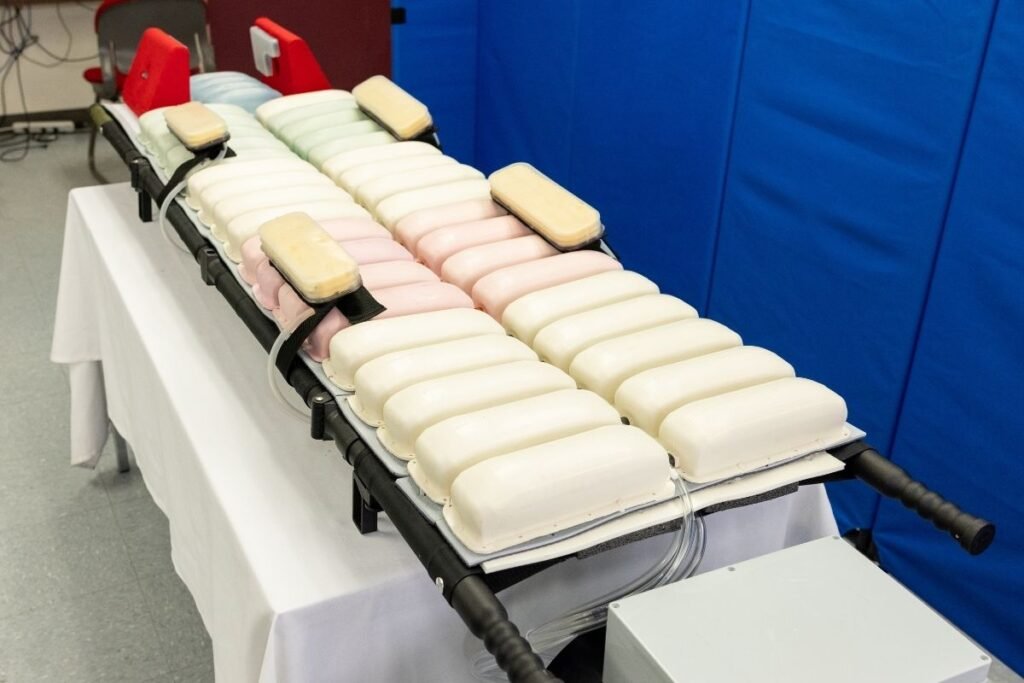
In emergency medicine, speed saves lives—but prolonged immobilization during transport can quietly cause harm. Pressure injuries, also known as bedsores or ulcers, are a serious risk for trauma patients who remain strapped to rigid spine boards for hours during evacuation. In fact, more than half of casualties transported during the Iraq War developed pressure injuries before reaching a hospital. Now, researchers at the University of Texas at Arlington (UTA) and UT Southwestern Medical School have developed a solution that could change the standard of care: an adaptive spine board (ASB) overlay that dynamically redistributes pressure to protect vulnerable patients.
The ASB overlay is designed to sit atop standard stretchers or spine boards and features a multi-zoned air-cell system divided into five anatomical regions: head and neck, upper trunk, buttocks and pelvis, thighs, and feet and heels. Each zone is equipped with sensor-driven pressure modulation, allowing the system to automatically adjust air pressure in real time to maintain optimal support. This means no single area of the body bears excessive weight for too long—a key factor in preventing tissue breakdown and cell death.
What sets the ASB apart is its autonomous adaptability. The system’s onboard algorithm compensates for environmental variables like temperature and barometric pressure, ensuring consistent performance whether in a hospital, ambulance, or combat zone. In testing, the ASB outperformed traditional immobilization surfaces, keeping pressure below the thresholds known to cause injury. That’s a major leap forward, especially for long-range transport scenarios that can last 16 hours or more.
While the ASB was initially developed with military applications in mind, its potential extends far beyond the battlefield. Civilian trauma care, spinal injury transport, disaster relief, and even space exploration could benefit from a system that protects patients during prolonged immobilization.
Article from UT Arlington: Adaptive Spine Board Could Revolutionize ER Transport
Abstract from Journal of Rehabilitation and Assistive Technologies Engineering: Development of an adaptive spine board overlay for interface pressure reduction during long-range aeromedical evacuation: Implication for pressure injury prevention
