
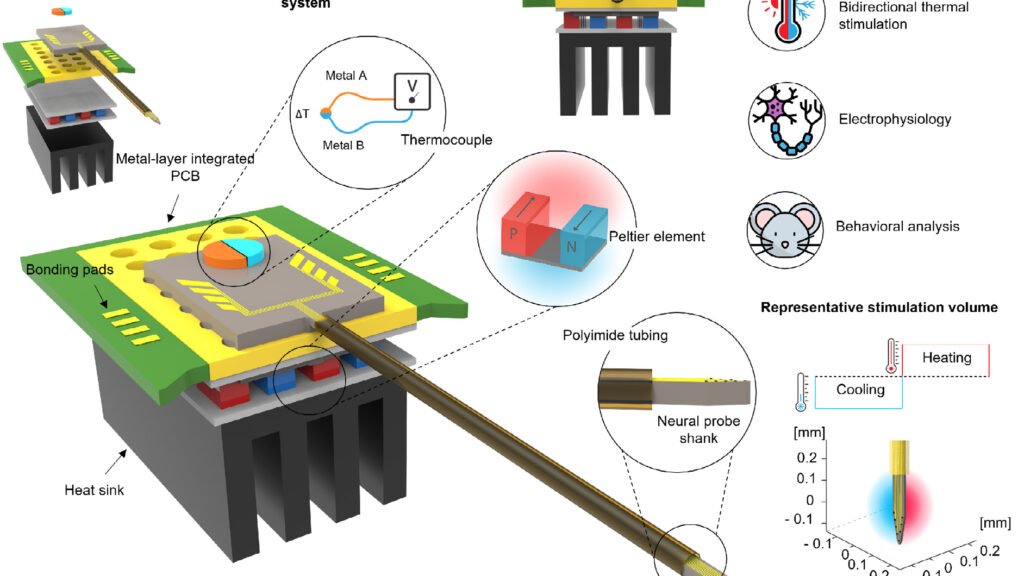
Neurological disorders remain difficult to treat because most neuromodulation technologies can only activate or suppress neural activity in one direction, limiting their ability to provide fine control over complex brain circuits. A research team at Korea University College of Medicine has developed a miniaturized brain implant that uses temperature to both increase and decrease neuronal activity, offering a new strategy for next‑generation brain–computer interfaces and closed‑loop neuromodulation systems. Their work demonstrates how localized heating and cooling can be delivered deep inside the brain to achieve targeted bidirectional control.
The implant integrates a thermoelectric Peltier device with a silicon‑based neural probe, allowing precise thermal modulation of specific brain regions. Because temperature naturally influences neuronal firing rates, cooling can suppress activity while heating can enhance it. This dual capability stands in contrast to existing electrical, magnetic, optical, ultrasonic and chemical stimulation methods, which typically operate in a single direction. The device also includes an electrode array that records neural signals during thermal stimulation, enabling real‑time monitoring of how neurons respond to changes in temperature.
Experiments showed that cooling reliably inhibited neural activity and heating increased it. The team applied the technology to the locus coeruleus, a region involved in arousal and attention. Thermal modulation not only altered neural firing patterns but also produced corresponding changes in pupil size, including both dilation and constriction. These results demonstrate that temperature‑based stimulation can influence both neural circuits and physiological outputs in a controlled and reversible manner.
The researchers highlight the importance of this approach for future brain–computer interfaces. Current systems focus primarily on decoding neural signals to control external devices, but emerging applications require delivering sensory information back to the brain. Bidirectional BCIs will need tools capable of both activating and inhibiting neural pathways to create realistic sensory feedback. The new implant provides a foundation for such systems by enabling selective modulation of targeted circuits.
The technology also shows promise for treating neurological and neurodegenerative disorders that are difficult to manage with conventional methods. By offering a single device capable of both suppression and activation, the implant could support closed‑loop therapies that adjust neural activity dynamically based on real‑time feedback. Researchers describes the work as a new concept in brain interface technology that may help restore neural function and expand therapeutic options for conditions that currently lack effective treatments.
Article from Korea University College of Medicine: Prof. Il-Joo Cho’s Research Team Develops a Novel Brain Implant for Bidirectional Control of Neural Activity Using Temperature
Abstract in Advanced Science: Miniaturized Bidirectional Thermal Stimulation System Integrated With an Electrode Array for Recording Neural Activities
