
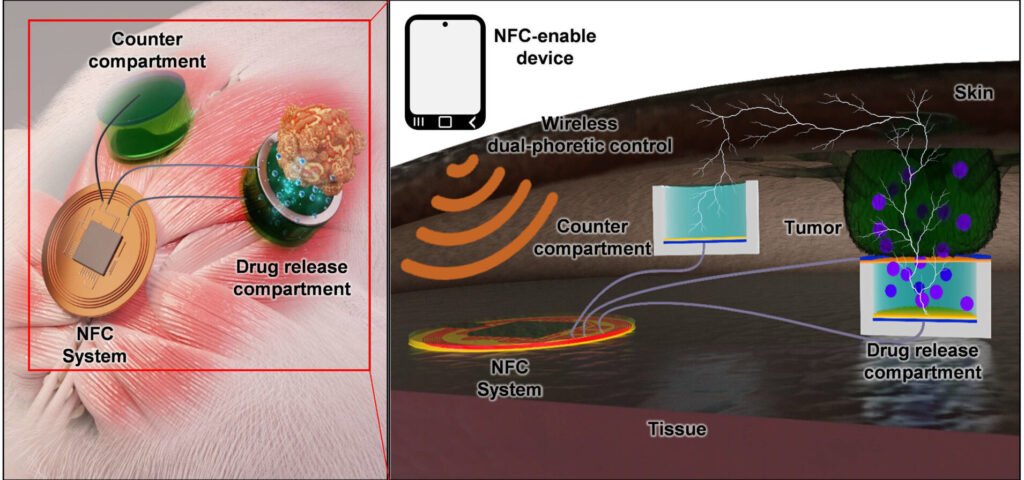
A multidisciplinary team led by Seoul National University has developed a wireless, implantable device that delivers chemotherapy drugs directly into solid tumors—dramatically improving treatment effectiveness while avoiding harmful side effects. Traditional chemotherapy often struggles to penetrate dense tumor tissue, requiring high systemic doses that can damage healthy organs and cause severe complications.
The new device, called the Dual-Phoretic Wireless Drug Delivery System (DPw-DDS), solves this problem by combining two drug transport methods: electrophoresis, which controls drug release using an ion-selective diode, and iontophoresis, which pushes the drugs deep into tumor tissue using electric fields. The system is powered wirelessly via near-field communication (NFC), eliminating the need for batteries or external wires.
In animal studies, the implant delivered over four times more drug into tumors compared to standard injections and reduced tumor size by more than 50% within five weeks. Importantly, it caused no damage to surrounding tissue or major organs. Because the system works with existing drugs and supports a wide range of therapies—including nanomedicines and mRNA—it could be rapidly adapted for clinical use.
The researchers are now working on biodegradable versions of the implant that wouldn’t need surgical removal, making long-term treatment even more convenient. This technology represents a major step forward in precision medicine, offering targeted, sustained drug delivery with minimal burden to the patient.
Article from SNU: Wireless Implant Delivers Chemotherapy Deep into Tumors—Without Side Effects
Abstract in Science Advances: Dual-phoretic wireless device for directionally oriented and carrier-free targeted drug delivery
