
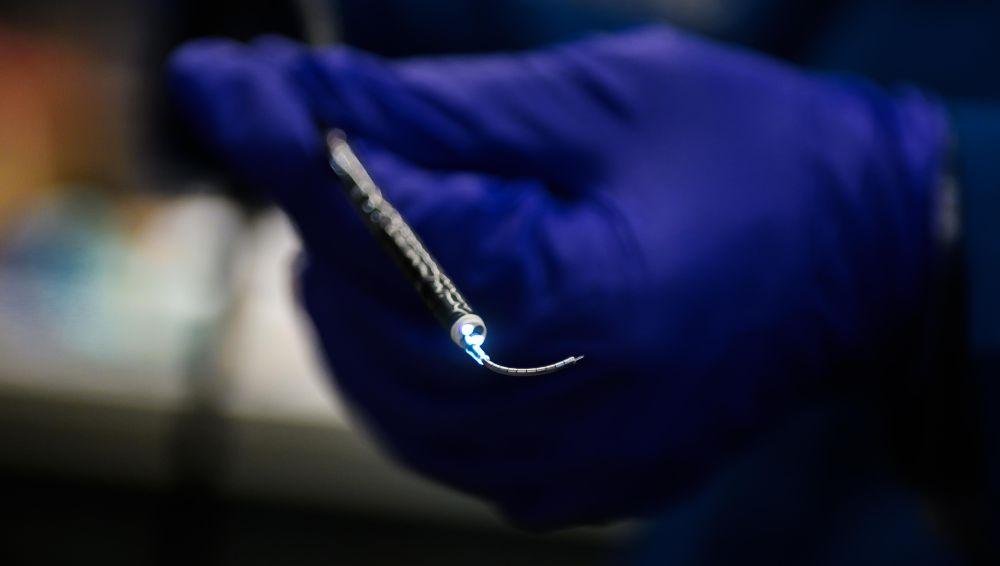
Laser surgery for growths on the vocal folds often requires general anesthesia because standard optical fibers cannot reach deep or angled areas of the larynx. This limitation leaves many patients without safe treatment options, especially those with heart conditions or other risks that make anesthesia dangerous. Researchers at Worcester Polytechnic Institute have developed a flexible optical fiber that can be guided through an endoscope and precisely steered to hard‑to‑reach spots, offering the possibility of performing these procedures safely in outpatient settings.
The new device consists of a thin nickel‑titanium sheath only 1.6 millimeters wide, with notches that allow it to bend. Inside the sheath runs an optical fiber that delivers laser light to destroy growths on the vocal folds. Surgeons can control the fiber’s direction using handheld controls, enabling access to areas that rigid tools cannot reach. In tests using a 3D‑printed model of a human larynx, the team successfully reached 57 of 70 target points, about 81 percent of locations that conventional fibers could not access.
This innovation could make laser treatment available to more patients, including those who cannot undergo general anesthesia. It also offers new possibilities for professional voice users such as singers and speakers, whose careers depend on precise vocal performance. The researchers plan to refine the design so the fiber can bend in multiple directions and be operated by a single clinician rather than two.
Article from WPI: Steering Toward Better Larynx Surgeries
Abstract in Journal of Medical Devices: Steerable Optical Fiber for Office-Based Laser Surgery of the Larynx: Design, Development, and Experimental Evaluation in a Phantom Model
