
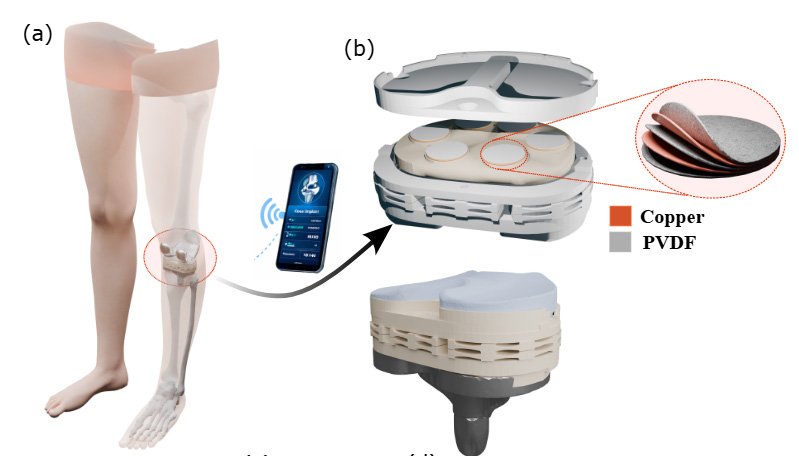
Knee replacements are meant to last a lifetime, yet many patients still face complications like joint loosening or imbalance that often go unnoticed until the damage is severe. With nearly 800,000 knee replacements performed each year in the United States — a number expected to rise sharply as the population ages — surgeons and patients need better ways to detect problems early. Researchers at Binghamton University are developing technology that could make future implants far smarter and far safer.
The team’s approach centers on tiny energy‑harvesting components called piezoelectric and triboelectric transducers. These materials generate small amounts of electricity when the knee bends, vibrates, or when surfaces slide against each other. Instead of relying on batteries, the implant would power itself using the patient’s natural movement. That same electrical output can also act as a built‑in sensor, because the amount of energy produced directly reflects the load on the joint.
Recent studies explored which materials and designs produce the most reliable power and the most accurate load measurements. The findings suggest that combining both piezoelectric and triboelectric mechanisms offers the best performance, giving the implant a steady, movement‑based power source and a sensitive way to detect abnormal forces.
To validate the technology, the researchers compared their prototypes against a sophisticated knee simulator that reproduces the joint’s full range of motion. The results showed strong agreement, giving the team confidence that the sensors can capture real‑world knee mechanics. The next steps involve sealing the device for long‑term durability and testing it in cadaveric knees to confirm biocompatibility and accuracy.
If successful, this work could lead to knee implants that quietly monitor themselves for years, alerting doctors to early signs of trouble and helping patients avoid painful revision surgeries. It represents a major step toward orthopedic implants that don’t just replace damaged joints — they actively protect them.
Article from Binghamton University: Binghamton University research moves closer to ’smart’ sensors in knee replacements
Abstract in IEEE/ASME Transactions on Mechatronics: Porous Triboelectric Nanogenerator for Load Sensing of Total Knee Replacement
