
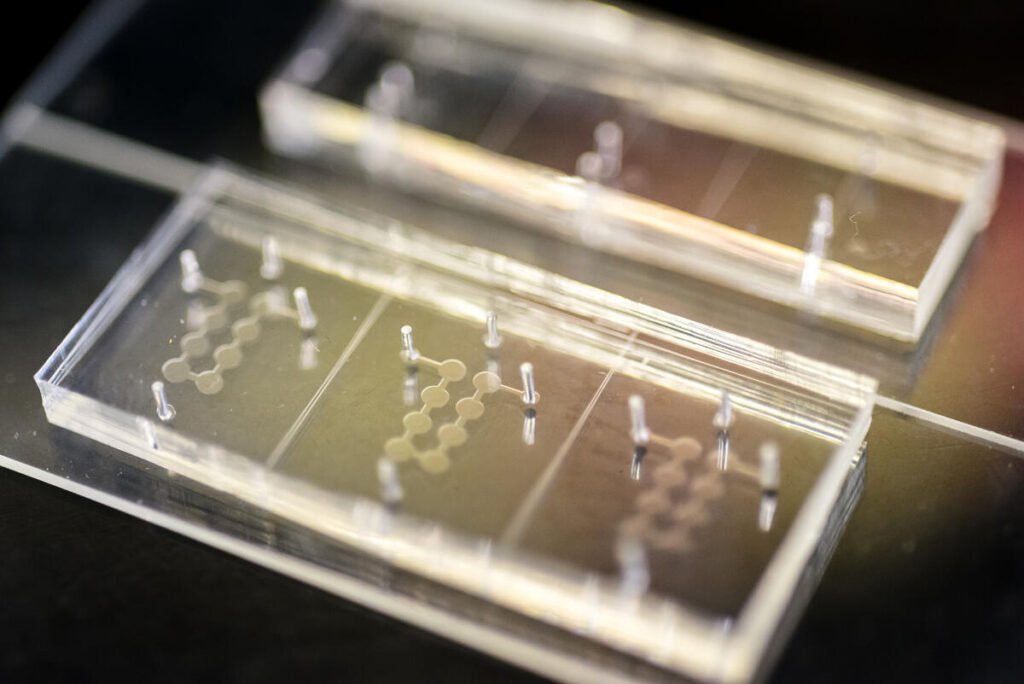
Age‑related diseases are rising quickly as more people live into their 60s, 70s, and 80s, yet scientists still lack fast, reliable ways to study how human tissues age or how potential anti‑aging treatments actually work. Traditional research tools are slow, expensive, and often fail to predict what will happen in real people. A team at the University of California Berkeley has created a new organ‑on‑a‑chip system that changes this landscape by recreating decades of human aging in just four days.
The technology uses tiny devices that hold human fat and liver cells grown from stem cells. These tissues sit in small, connected chambers that allow fluid to flow between them, much like blood moves between organs in the body. Because the system is so small and efficient, it can run experiments using only tiny amounts of human blood serum. This makes it possible to test how real human aging signals affect tissues without waiting years for changes to appear.
When the researchers flowed serum from older adults through the chip, the tissues quickly began to behave like aged human organs. They became more inflamed, struggled to regulate sugar and fat, and showed signs of cellular slowdown and stress. These are changes that normally take decades to develop in the body, yet the chip reproduced them in a matter of days. The system also revealed how aging spreads from one organ to another. When aged fat tissue was connected to young liver tissue, the liver began to show aging features as well, mirroring the whole‑body nature of aging in humans.
The platform also uncovered differences between male and female aging patterns. Serum from men produced stronger signs of inflammation and faster aging in the tissues, while serum from women created more varied responses, likely reflecting the complex hormonal changes that occur with age.
One of the most powerful aspects of the system is its ability to rapidly test potential anti‑aging treatments. Several well‑known candidates were evaluated, and the hormone oxytocin stood out for its ability to reduce inflammation, lower cellular stress, and restore healthier metabolism. Other treatments showed more limited benefits, and some widely discussed longevity drugs had little effect. The chip also identified new biological markers of aging and allowed researchers to adjust gene activity directly within the tissues.
Article from Cal: Organ-on-a-chip technology replicates decades of human aging in just four days
Abstract in Nature Biomedical Engineering: Human microphysiological systems of aging recreate the in vivo process expediting evaluation of anti-geronic strategies
