
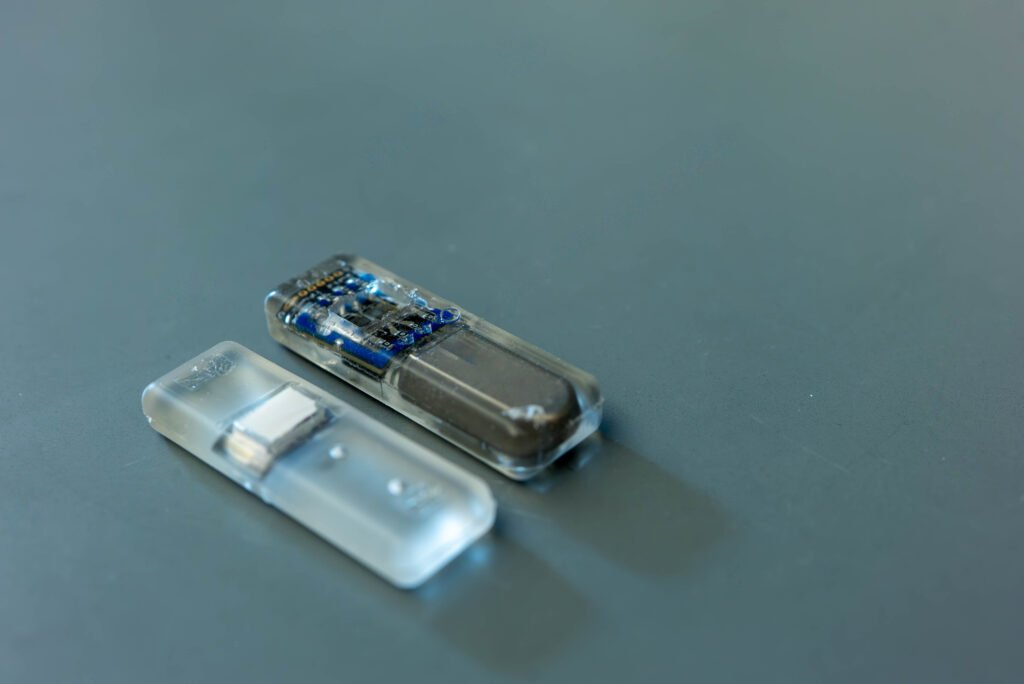
Cell‑based drug delivery has long promised a way to provide continuous, therapeutic‑level dosing from a single implant, but the approach has been limited by a fundamental biological constraint: densely packed cells cannot survive without a steady supply of oxygen. This challenge becomes even more severe under the skin, a minimally invasive implantation site that is convenient and low risk but poorly oxygenated. Researchers at Rice University, together with collaborators at Carnegie Mellon University and Northwestern University, have engineered a compact implant that solves this oxygen problem while also protecting therapeutic cells and supporting high‑density drug production.
The system, called the Hybrid Oxygenation Bioelectronics system for Implanted Therapy, or “HOBIT”, integrates several innovations into a single device. It houses engineered cells in a small chamber while shielding them from the host immune system and ensuring that nutrients and secreted biologics can flow freely. The key advance is a miniaturized electrocatalytic oxygenator that generates oxygen directly inside the implant. Using an iridium oxide‑based surface powered by an onboard battery, the oxygenator splits water in surrounding tissue to produce oxygen without harmful byproducts. Earlier versions required external wiring, but the new design is fully wireless and can be remotely adjusted to modulate oxygen output.
A Rice researcher explained that cells packed into dense clusters quickly compete for oxygen, and subcutaneous tissue cannot supply enough to sustain the number of cells needed for clinically meaningful drug doses. By generating oxygen locally, HOBIT supports cell densities roughly six times higher than conventional encapsulation systems. A researcher from Northwestern noted that producing oxygen exactly where cells need it allows the device to remain small while maintaining high therapeutic output.
HOBIT uses a two‑stage encapsulation strategy to protect the engineered cells. First, the cells are microencapsulated in alginate hydrogel beads. These microcapsules are then loaded into a larger chamber made from a semipermeable membrane that blocks immune attack while allowing nutrients and biologics to pass. The team engineered the encapsulated cells to continuously produce three different therapeutic molecules: an antibody, a hormone, and exenatide, a GLP‑1‑like drug.
In rat studies lasting 30 days, oxygenated implants maintained stable blood levels of all three biologics, while control devices without oxygenation showed rapid declines. Short‑half‑life molecules became undetectable by day seven in the controls, and longer‑lasting molecules steadily decreased. At the end of the study, about 65 percent of cells in oxygenated devices remained viable compared to roughly 20 percent in controls.
According to researchers, the results show that compact, high‑density cell factories are feasible when oxygenation is engineered directly into the implant. The team plans to pursue larger‑animal studies and disease‑specific applications, including diabetes, where transplanted islets have high and variable oxygen demands. The researchers view HOBIT as a foundational platform for future therapies that combine multiple engineered cell types, regulated secretion, and integrated sensing electronics within a retrievable device.
Article from Rice University: Solving the oxygen problem in cell-based drug delivery
Abstract in Device: Design of a wireless, fully implantable platform for in-situ oxygenation of encapsulated cell therapies
