
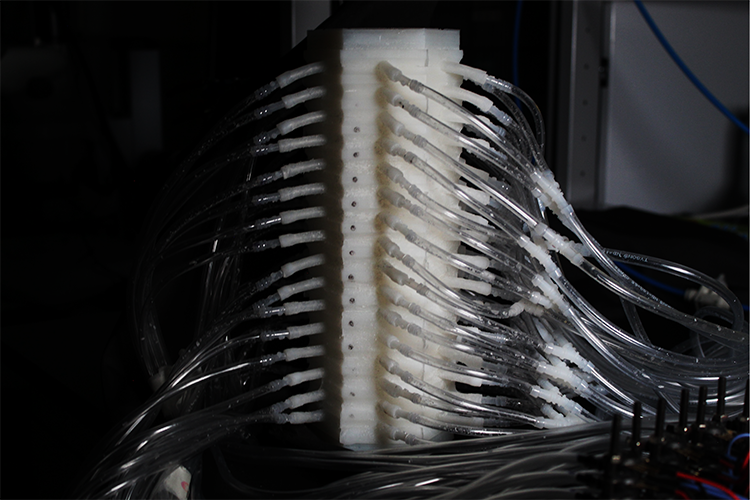
Swallowing disorders affect hundreds of millions of people worldwide, yet researchers have lacked a realistic way to study how the esophagus actually moves during a swallow. Existing benchtop models cannot reproduce the coordinated muscle activity that drives food from the throat to the stomach, leaving major gaps in understanding dysphagia and limiting the development of effective treatments. A team at University College Dublin, working with collaborators at MIT and Harvard Medical School, has created the first robotic system capable of accurately replicating the complex mechanics of human swallowing.
The device, called “RoboGullet”, uses soft‑robotic components to mimic the two distinct muscle layers of the esophagus, which must contract in a coordinated sequence to move food efficiently. Previous laboratory models could not reproduce this interplay, making it impossible to simulate many motility disorders, including achalasia. RoboGullet overcomes this limitation by independently controlling each muscle layer, allowing researchers to recreate both healthy swallowing and a wide range of disease states.
The researchers explain that while accurate benchtop models exist for organs like the heart, no system has previously captured the physical and functional behavior of the esophagus. RoboGullet fills that gap by providing a controllable, repeatable platform that mirrors real biomechanics. The team also developed a biohybrid version incorporating real tissue, which adds frictional properties that further enhance realism.
The study demonstrates the model’s versatility across clinically relevant applications. Researchers used it to test esophageal stents, which are commonly placed in cancer patients but often migrate unpredictably. RoboGullet allowed the team to analyze how stents behave under different conditions and how disease‑related changes in muscle motion influence their stability. The system also enabled controlled testing of how various food textures affect swallowing performance, offering a new tool for improving diagnostic accuracy and guiding dietary recommendations for patients with dysphagia.
Researchers also note that the device replaces inappropriate preclinical models and provides insights into factors that influence stent migration and patient‑specific dietary tolerance. They add that RoboGullet serves as a powerful translational tool for studying esophageal motility and evaluating therapeutic interventions.
By bridging the gap between simplified laboratory models and complex clinical studies, RoboGullet offers a realistic, adaptable platform that could accelerate the development of new treatments, improve diagnostic methods, and support personalized care for people with swallowing disorders.
Here’s a video explaining more about RoboGullet:
Article from UCD: UCD team recreate human swallowing in world-first robotic model
Abstract in Nature Communications: A Soft-Robotic Biomimetic Benchtop Model for Esophageal Motility Simulation
