
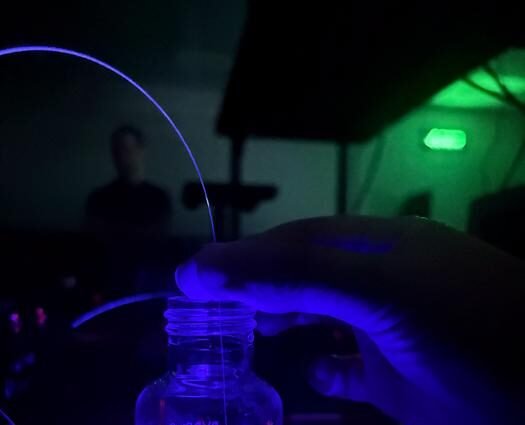
Detecting cancer early often depends on sensing subtle molecular changes inside the body, yet most tools can only measure one biomarker at a time and struggle to operate reliably in living tissue. This limitation makes it difficult for clinicians to distinguish cancer‑related signals from other biological activity. Researchers from Adelaide University’s Institute for Photonics and Advanced Sensing, working with the University of Stuttgart, have developed microscopic sensors that address these challenges by combining multi‑signal detection, minimally invasive design, and advanced 3D micro‑printing.
The team created sensors as thin as a human hair and printed them directly onto the tips of optical fibers. These devices can measure several signals simultaneously, including temperature and chemical changes, while targeting specific biomarkers linked to cancer. The researchers explain that the sensors provide clear, reliable information about disease presence in a way that minimizes disruption to surrounding tissue. Their ability to track multiple indicators at once could support real‑time monitoring, guide treatment decisions, and improve diagnostic accuracy.
The technology works by detecting light emitted from molecules that interact with a by‑product of cancer. The amount of emitted light corresponds to the concentration of cancer‑related molecules. By inserting the fiber‑mounted sensors into tissue and measuring this light, the researchers believe they can determine whether cancer is present. This approach builds on existing methods but significantly expands capability, since earlier tools could measure only one biomarker at a time. Afshar notes that measuring multiple signals in a living environment is extremely difficult, and the new method overcomes this barrier by providing immediate, precise information to medical professionals.
The researchers aim to collaborate with hospitals to refine the sensors and prepare them for clinical use. They say the technology could be ready within the next decade, offering a new class of minimally invasive tools for cancer detection and broader biomedical applications.
News Release: Tiny sensors with the power to detect cancer
Abstract in Advanced Optical Materials: 3D Microprinting of Structures with Lanthanide-Based Fluorophores on Optical Fibers for Multiplexed Sensing
