
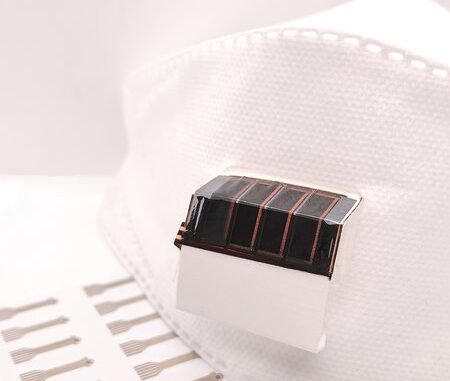
Monitoring health through exhaled breath has long been limited by the difficulty of collecting reliable samples over extended periods. Traditional approaches struggle because breath condensate dries quickly, sensors degrade in humid environments, and wearable systems depend on batteries that require recharging or replacement. These constraints have prevented continuous, noninvasive breath‑based monitoring from becoming a practical tool for everyday health assessment. Researchers at the California Institute of Technology have now addressed these limitations by developing a new version of their smart mask that operates without a battery, maintains stable sensing performance for days, and captures a wider range of biochemical information from exhaled breath.
The upgraded platform, called “EBClite”, builds on an earlier prototype introduced in 2024. The first step in collecting breath data is cooling exhaled air using a hydrogel to produce exhaled breath condensate, which contains metabolites, pathogens, and inflammatory markers. Earlier hydrogels dried out within hours, sharply limiting monitoring duration. The Caltech team, working with collaborators in Austria and Hong Kong, created a lithium‑chloride‑infused hydrogel that resists drying and can be easily rehydrated, allowing the mask to function for many days without losing its ability to capture condensate.
Sensor durability posed another challenge. Because the sensing components operate in a high‑humidity environment and undergo repeated wet‑dry cycles, earlier versions degraded over time. The researchers encapsulated the sensors in a flexible multilayer material that protects them from moisture fluctuations while preserving sensitivity. This design enables real‑time chemical analysis of breath samples with improved stability during prolonged use.
To eliminate the need for a battery, the team integrated an ultrathin solar cell capable of harvesting energy even from weak indoor light. This allows the mask to operate continuously during daily activities without recharging. The entire system remains low cost, with materials priced at roughly one dollar per mask, making long‑term use feasible for a wide range of users.
With the upgraded mask, the researchers expanded their focus beyond respiratory disease markers to include lactate, a key indicator of metabolic activity. Tests with healthy volunteers showed that lactate levels in exhaled breath rose during physical activity in patterns similar to blood measurements. The team also monitored lactate after carbohydrate consumption to assess metabolic responses. Because exhaled breath condensate is collected passively, the platform is well suited for children, older adults, and critically ill patients.
The researchers are now exploring deployment in low‑resource settings. They also plan to expand the range of biomarkers the system can detect, with the goal of creating a general‑purpose, daily‑wear health‑monitoring platform.
Article from Caltech: Extracting More Information from Exhaled Breath
Abstract in Nature Sensors: A battery-free smart mask for long-term exhaled breath biochemical sensing
