
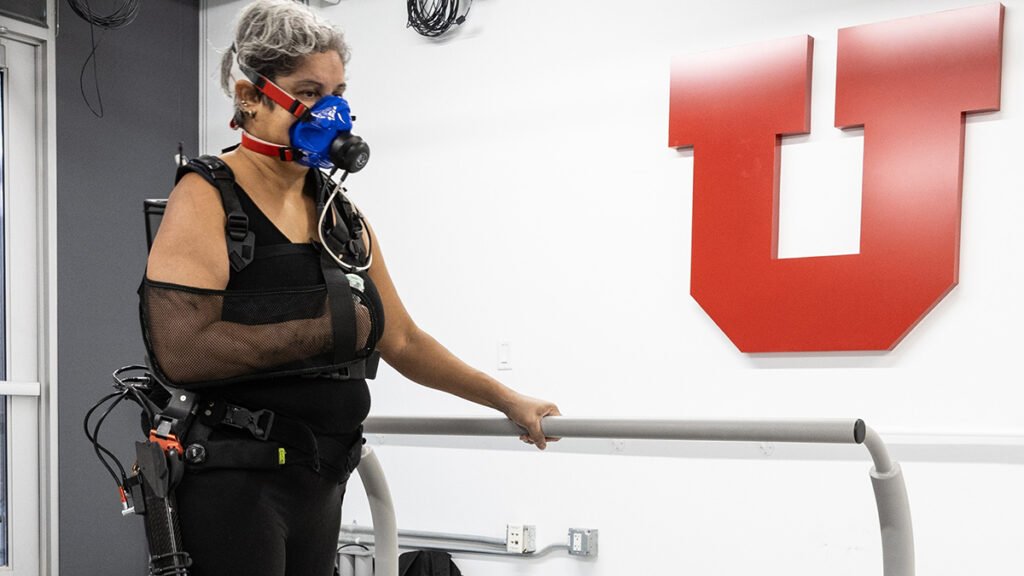
Engineers at the University of Utah have introduced a lightweight robotic exoskeleton designed to help stroke survivors walk with greater stability and symmetry, addressing one of the most persistent challenges in post‑stroke rehabilitation. Many individuals who experience a stroke develop long‑term gait impairments that make walking tiring, inefficient, and unsafe. Traditional therapy can improve mobility, but progress often plateaus, and existing robotic devices tend to be bulky, expensive, or limited to clinical settings. The Utah team set out to create a wearable system that is comfortable enough for daily use while still providing meaningful biomechanical assistance.
The device attaches to the user’s leg and uses small motors and sensors to support the weakened side during walking. By applying targeted torque at the right moment in the gait cycle, the exoskeleton helps the affected leg swing forward more naturally and reduces compensatory movements that can strain joints or increase fall risk. The researchers emphasize that the system is designed to work with the user’s own movement rather than forcing a rigid pattern, allowing the nervous system to relearn healthier walking mechanics over time.
A key achievement of the project is the exoskeleton’s low weight. The team engineered the device to be significantly lighter than many commercial systems, making it more practical for home use and long‑duration wear. Early testing with stroke survivors showed improvements in gait symmetry and reduced effort during walking. Participants reported that the device felt intuitive and supportive, suggesting that it could complement traditional therapy by enabling more frequent practice outside the clinic.
The researchers plan to continue refining the design, exploring how the exoskeleton could be personalized to each user’s gait pattern and integrated into long‑term rehabilitation programs. They also envision future versions that adapt automatically to the user’s progress. By combining portability with targeted biomechanical assistance, the Utah exoskeleton offers a promising path toward improving mobility and independence for people recovering from stroke.
Here’s a video that shares more about the exoskeleton:
Article from the University of Utah: U engineers demonstrate lightweight ‘exoskeleton’ that helps stroke survivors walk
Abstract in Nature Communications: Portable hip exoskeleton improves walking economy for stroke survivors
