
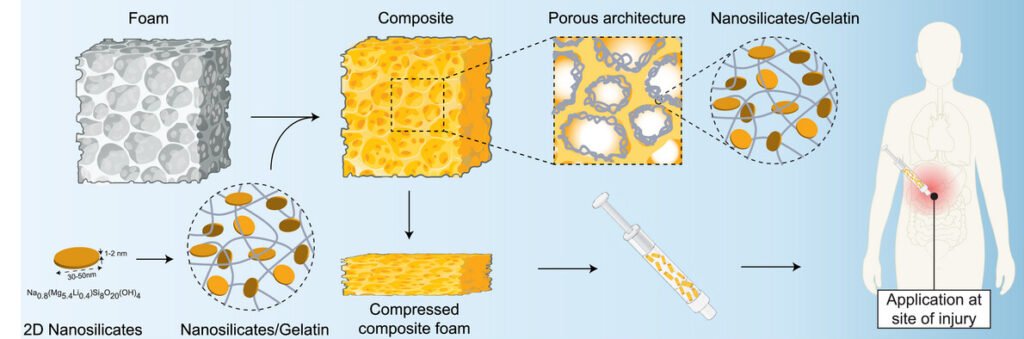
A new advance from Texas A&M University is reshaping how emergency teams might treat severe bleeding, one of the most urgent challenges in trauma medicine. Researchers there have engineered a modified clay material that can halt dangerous blood loss within seconds, addressing a critical need in both civilian emergencies and battlefield conditions. Hemorrhage remains a leading cause of preventable death after injury, and existing hemostatic agents often fail to act quickly enough or safely enough under extreme circumstances.
The team focused on transforming naturally occurring clay minerals into a medical‑grade material with optimized surface chemistry. When applied to a wound, the clay rapidly absorbs plasma, concentrates clotting factors, and triggers a fast coagulation response. Laboratory tests showed that the engineered clay outperformed several commercial products, particularly in high‑pressure arterial bleeding scenarios where rapid clot formation is essential. The researchers also emphasized that the material is inexpensive, easy to manufacture, and stable across a wide range of temperatures, making it suitable for field kits and disaster response.
A major design priority was ensuring that the clay would not generate excessive heat or damage surrounding tissue, a known issue with some earlier mineral‑based hemostats. By controlling particle size and reactivity, the team created a formulation that avoids these complications while maintaining strong clotting performance. Early biocompatibility studies indicate that the material does not provoke harmful inflammation and can be removed without causing additional trauma. The researchers plan to continue evaluating the material in preclinical models and exploring how it could be integrated into dressings, sponges, or injectable systems.
By refining a widely available mineral into a high‑performance medical tool, the Texas A&M team has introduced a promising option for controlling severe bleeding before patients reach definitive care. The technology could help reduce preventable deaths in emergency medicine, military operations, and remote environments where rapid intervention is essential.
Article from Texas A&M: Stopping Fatal Blood Loss with Clay
Abstract in Advanced Science: Expandable Nanocomposite Shape-Memory Hemostat for the Treatment of Noncompressible Hemorrhage
