
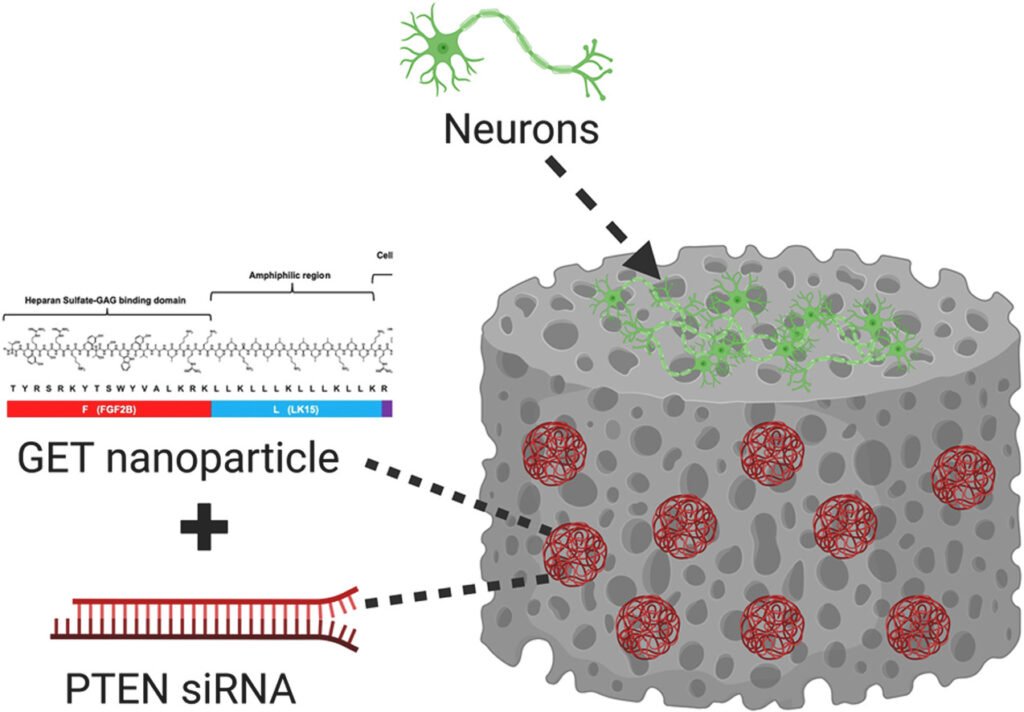
Researchers at the Royal College of Surgeons in Ireland (RCSI) University of Medicine and Health Sciences have developed a 3D implant that delivers RNA‑carrying particles directly to damaged nerve cells to promote regeneration after spinal cord injury. The implant is engineered to mimic the structure and stiffness of the spinal cord, creating a supportive environment that encourages neurons to grow rather than forming scar tissue that blocks recovery. The implant addresses the long‑standing challenge that injured neurons in the central nervous system rarely regenerate on their own, leading to permanent paralysis for many patients.
The implant contains tiny particles designed to carry therapeutic RNA sequences that activate growth pathways inside injured neurons. By placing these particles directly at the injury site, the system avoids the limitations of systemic delivery, where RNA molecules degrade quickly or fail to reach the target tissue. Laboratory testing showed that neurons exposed to the RNA‑loaded implant extended new projections, demonstrating early signs of functional regrowth. The researchers emphasize that the implant’s biomimetic architecture is essential because it provides both mechanical support and biochemical cues that guide nerve repair.
Spinal cord injuries often trigger inflammation and scar formation that create a physical and chemical barrier to regeneration. The RCSI team designed the implant to counteract these processes by combining structural scaffolding with targeted molecular therapy. Their findings suggest that this dual approach could improve outcomes compared with strategies that rely solely on biomaterials or drugs. The work was supported by Research Ireland and the Irish Rugby Football Union Charitable Trust, reflecting growing interest in regenerative technologies for neurological injuries. The researchers plan to advance the implant toward preclinical testing to evaluate long‑term safety and functional recovery.
Article from RCSI: RCSI researchers develop RNA-activated implant to stimulate nerve regrowth after spinal cord injury
Abstract in Bioactive Materials: Development of a PTEN-siRNA activated scaffold to promote axonal regrowth following spinal cord injury
