
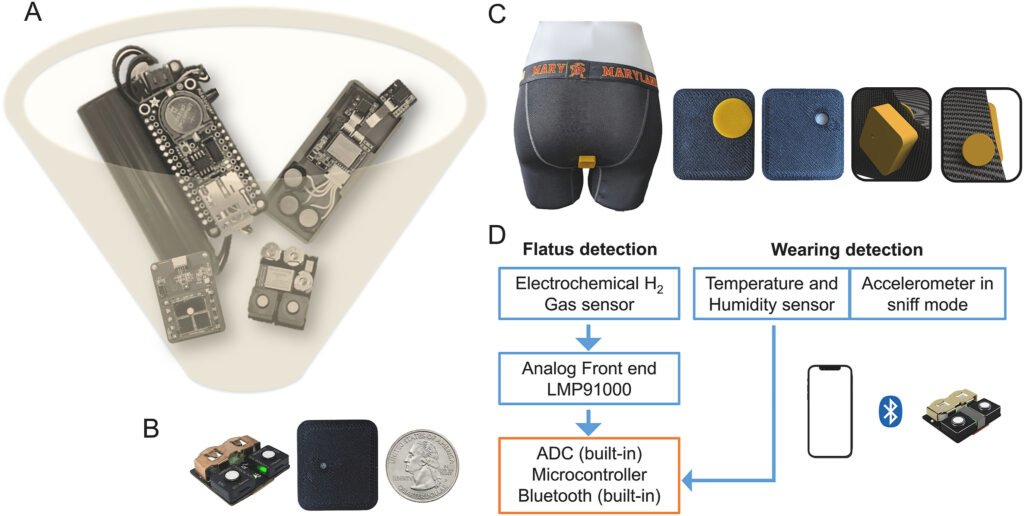
Scientists at the University of Maryland have developed a small wearable sensor, nicknamed “Smart Underwear”, that clips onto any pair of underwear and continuously measures human flatulence by detecting hydrogen gas. The device was created to address a long‑standing gap in gastrointestinal research: despite how common digestive complaints are, clinicians have had no reliable way to quantify gas production in daily life. As the researchers note, even experts have struggled to document what patients describe, leaving gut health a bit of a black box. Smart Underwear aims to clear the air by providing objective, real‑time data on microbial activity.
The system uses an electrochemical sensor that passively records hydrogen levels throughout the day. In a study of 38 participants, the device detected dietary changes with 94.7 percent accuracy and revealed that people pass gas far more frequently than they believe. Participants averaged 32 flatulence events per day, compared with the widely cited estimate of 10 to 20. This finding suggests that humans may be less aware of their own emissions than previously assumed, and that self‑reporting is not a reliable measure of gut function. In other words, the gut has been quietly speaking up all along, and now the sensor finally lets researchers listen.
The team emphasizes that the device is not a novelty item but a scientific tool designed to capture continuous metabolic output from gut microbes. Traditional microbiome studies rely on stool samples or genetic sequencing, which provide only snapshots rather than ongoing functional data. Smart Underwear offers a way to monitor how the gut responds to food, stress, medication, and daily rhythms. This could help identify patterns linked to digestive disorders or dietary sensitivities and support more personalized nutrition strategies. It also avoids invasive procedures, since the sensor simply clips onto clothing and operates discreetly for up to a week.
By quantifying something that has historically been more joked about than measured, the researchers have opened a new path for understanding gut health. The device provides a practical and accessible method for studying microbial activity in real‑world conditions. It also demonstrates that even the most overlooked bodily signals can carry meaningful scientific information. Sometimes progress really does come from following the wind.
Article from UMD: UMD Scientists Create ‘Smart Underwear’ to Measure Human Flatulence
Abstract in Biosensors and Bioelectronics: X: Smart underwear: A novel wearable for long-term monitoring of gut microbial gas production via flatus
