
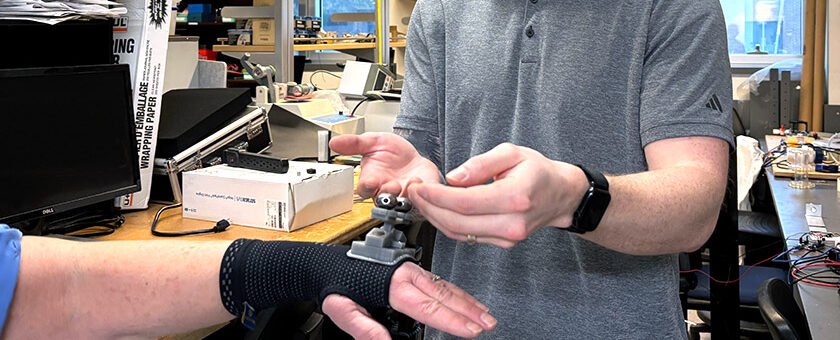
A research team at the University of British Columbia Okanagan has developed a lightweight wearable brace designed to reduce involuntary hand tremors associated with neurological conditions such as Parkinson’s disease. Hand tremors affect millions of people worldwide and can interfere with essential daily activities including eating, writing, and personal care. Existing treatments often rely on medication or surgery, while many wearable devices are bulky, expensive, or uncomfortable. The new brace aims to provide a noninvasive, accessible alternative that can be used in everyday life without requiring power sources or complex mechanisms.
The device works by mechanically inhibiting tremor motion rather than using motors or electronic stabilization. In laboratory tests using a mannequin arm, the brace reduced tremors by nearly eighty percent in one direction and more than seventy percent overall. These results demonstrate that a purely mechanical system can meaningfully suppress involuntary movement while allowing voluntary motion to continue.
The brace is designed to be lightweight and comfortable, addressing a common limitation of previous wearable solutions. Because it does not rely on batteries or motors, it avoids issues such as weight, noise, charging requirements, and mechanical failure. The researchers emphasize that accessibility was a central design goal, as many individuals with tremors lack access to advanced medical devices or cannot tolerate invasive procedures. The team’s findings suggest that the brace could be used as a practical daily aid for people with tremors linked to Parkinson’s disease and other neurological conditions.
Article from UBCO: Helping hands: UBCO research team develops brace to reduce tremors
Abstract in Journal of Medical Engineering & Technology: Experimental and computational analysis and testing of wearable hand tremor control orthoses
