
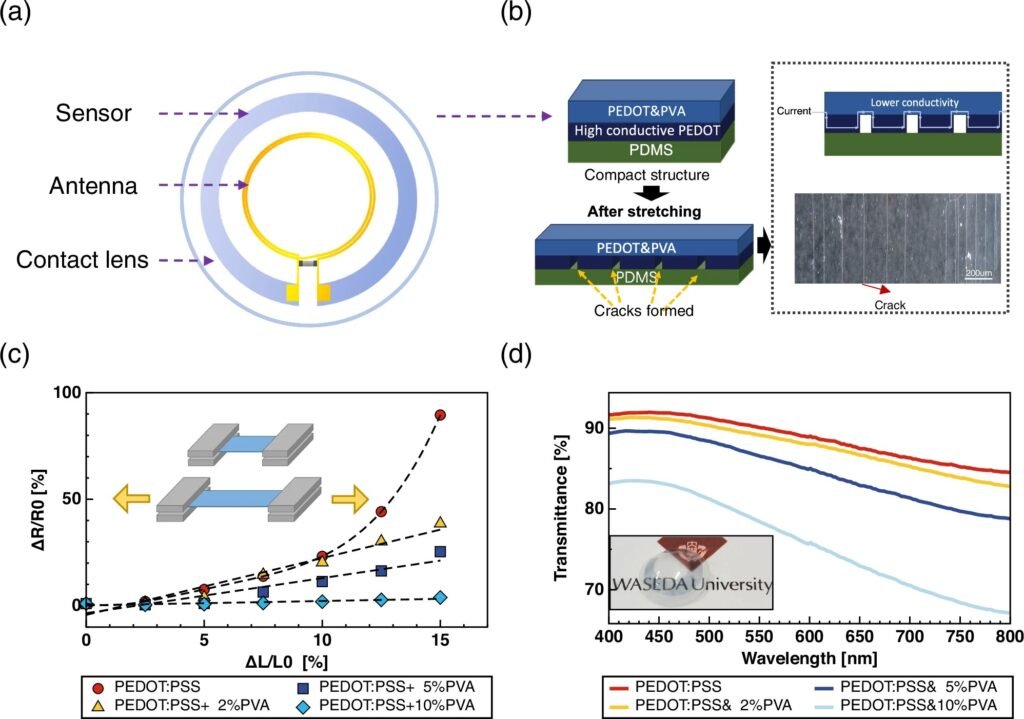
A research team at Waseda University has developed a soft, integrated smart contact lens capable of real time intraocular pressure monitoring using ultra sensitive wireless technology. The innovation is designed to support early diagnosis and management of glaucoma, a chronic eye disease that affects millions and remains a leading cause of blindness. Existing tools for measuring intraocular pressure are bulky, non portable, and incapable of continuous monitoring, which limits their effectiveness in daily use. The new lens addresses these limitations by embedding a thin film sensor directly into a wearable contact lens platform.
The sensor is based on a cracked PEDOT:PSS/PVA (PEDOT: Poly(3,4-ethylenedioxythiophene); PSS: Poly(styrenesulfonate); PVA: Polyvinyl alcohol) thin film, which combines the mechanical flexibility of polyvinyl alcohol with the conductive properties of PEDOT and PSS. This multilayer structure allows the lens to conform to the eye while maintaining sensitivity and comfort. The device integrates a 70 MHz double loop gold antenna for wireless signal transmission and uses parity time symmetry wireless technology to dramatically enhance detection sensitivity. Compared to conventional wireless sensing systems, the new approach increases sensitivity by a factor of 183, enabling more precise and reliable measurements.
In vitro tests using porcine eyes and in vivo tests in rabbit models demonstrated strong linear correlation between the lens readings and commercial tonometer measurements. These results confirm that the lens can accurately track intraocular pressure in real time, even during normal daily activities. The researchers emphasize that the device’s microfabrication process allows it to fit comfortably on the eye without compromising flexibility or user experience.
The development is particularly relevant for aging populations, such as in Japan, where glaucoma prevalence is expected to rise. Continuous, noninvasive monitoring could help patients detect pressure changes early and adjust treatment before irreversible damage occurs. The team believes the platform could be adapted for long term use and integrated into broader ocular health management systems.
By combining advanced materials, wireless engineering, and biomedical design, the smart contact lens represents a significant step toward wearable diagnostics that operate seamlessly in everyday life. The work highlights how parity time symmetry principles can be applied to enhance biosensing performance and opens new possibilities for real time monitoring of other physiological parameters using soft, unobtrusive devices.
Article from Waseda University: Integrated Smart Contact Lens Technology for Real-Time Intraocular Pressure Monitoring Share Integrated Smart Contact Lens Technology for Real-Time Intraocular Pressure Monitoring
Abstract in npj Flexible Electronics: Ultra-sensitive real-time monitoring of intraocular pressure with an integrated smart contact lens using parity-time symmetry wireless technology
