
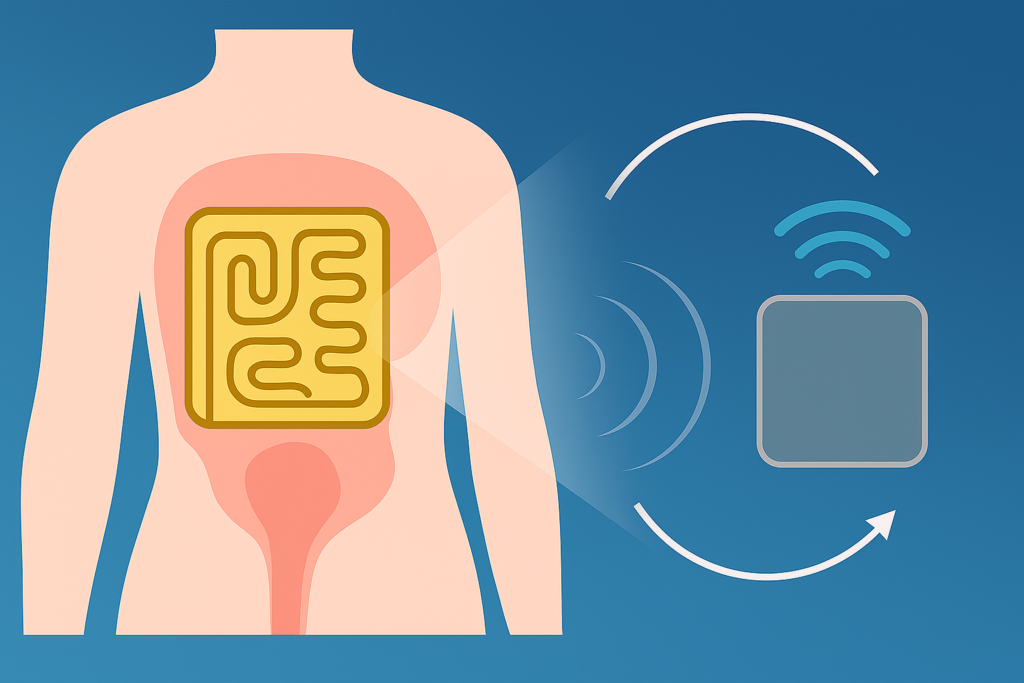
A research team at the Institute of Mechanics of the Chinese Academy of Sciences has developed a soft, biodegradable wireless implant capable of monitoring internal physiological signals over long distances and wide angles. The device is designed to overcome major limitations in current passive implantable sensors, which typically require extremely close readout distances and strict alignment between the sensor and the external reader. These constraints make clinical use difficult, especially when the implant is located deep within the body or when patient movement alters the sensor’s orientation.
The new system uses a passive inductor capacitor resonant circuit, allowing the implant to operate without batteries or magnets. Traditional passive systems suffer from short readout ranges because their resonant response weakens rapidly with distance and angle. To address this, the researchers analyzed coupled multi oscillator equations in passive wireless systems and identified how pole zero frequency separation and the imaginary component of the pole influence signal behavior. Based on this analysis, they introduced a pole moving sweeping readout method that differs from conventional stationary pole frequency sweeps. This approach increases readout distance, improves robustness, and reduces sensitivity to positional changes between the implant and the external reader.
The team also developed a multilayer serpentine inductor capacitor structure using localized plastic twisting and folding. This integrated folded design increases inductance and capacitance without relying on non degradable soldering. The resulting multi neutral axis serpentine architecture enhances flexibility and stretchability while reducing high frequency current losses caused by skin and proximity effects. These mechanical and electromagnetic optimizations allow the implant to remain soft, flexible, and fully biodegradable while still achieving strong wireless performance.
In vivo testing in the abdominal cavity of horses demonstrated that the implant could reliably capture deep tissue pressure and temperature at distances up to sixteen centimeters. Ex vivo experiments showed accurate strain sensing without requiring precise alignment between the sensor and the reader. The combination of long distance readout, wide angle tolerance, and biodegradable construction positions the technology as a promising platform for monitoring internal physiological signals in clinical settings where traditional passive sensors fail.
The work highlights how integrating mechanics, materials science, and electromagnetic design can produce implants that are both biologically compatible and functionally robust. By enabling long range, orientation independent sensing, the technology offers a path toward safer and more practical monitoring of deep tissue conditions without the need for batteries, wires, or device retrieval surgeries.
Article from the Chinese Academy of Sciences: Researchers Develop Soft Biodegradable Implants for Long-distance and Wide-angle Sensing
Abstract in Nature: Soft biodegradable implants for long-distance and wide-angle sensing
