
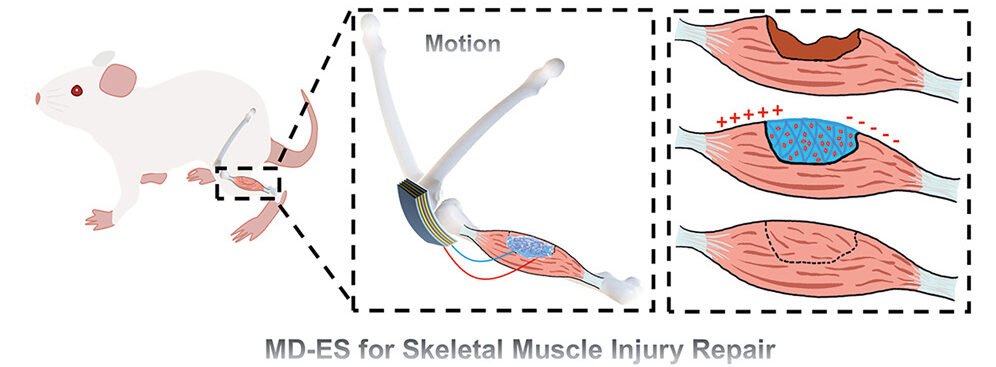
Severe skeletal muscle injuries, especially volumetric muscle loss where large portions of muscle are destroyed, remain difficult to treat because the body struggles to regenerate such extensive damage on its own. Addressing this challenge, researchers at the Institute of Process Engineering of the Chinese Academy of Sciences have developed a fully biodegradable, self powered implantable electrical stimulation system designed to enhance muscle repair. The device, called the muscle defect electrical stimulation (MD ES) system, delivers controlled electrical cues directly to injured tissue without relying on external power sources or bulky hardware, aiming to provide sustained therapeutic stimulation while maintaining patient comfort.
The MD ES system integrates a biodegradable triboelectric nanogenerator with an implanted electrode structure that conforms to the defect site. Normal body movements generate mechanical energy, which the triboelectric component converts into electrical pulses that are then delivered to the damaged muscle. This self powered design eliminates the need for batteries or wired connections, reducing the risk of infection and simplifying implantation. Because all components are made from biodegradable materials, the system gradually breaks down in the body after completing its therapeutic role, avoiding the need for a second surgery to remove the device.
Preclinical studies showed that muscles treated with the MD ES system exhibited improved regeneration compared with untreated controls, including better restoration of muscle structure and function. Electrical stimulation promoted the alignment and maturation of new muscle fibers and enhanced vascularization, both of which are critical for durable recovery. The researchers report that the device maintained stable output during the treatment period and that its degradation products were biocompatible, indicating good safety potential for future clinical translation.
The work demonstrates how combining biodegradable materials with self powered electronics can create temporary implants that actively guide tissue repair and then disappear once healing is complete. This approach could be particularly valuable for large muscle defects where conventional surgical reconstruction and passive scaffolds are not sufficient to restore function. The team suggests that the MD ES concept may be adaptable to other tissues that respond to electrical cues, such as nerves or cardiac muscle, opening a broader avenue for regenerative medicine devices that integrate stimulation, sustainability, and patient comfort in a single platform.
Article from the Chinese Academy of Sciences: Researchers Develop Biodegradable, Self-powered Electrical Stimulator for Muscle Repair
Abstract in Cell Biomaterials: Fully biodegradable, self-powered electrical stimulator for enhanced muscle repair
