
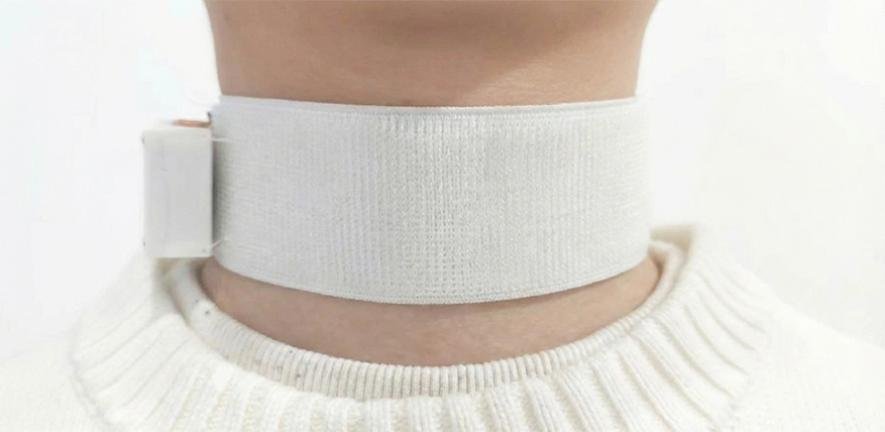
A soft, flexible wearable device developed at the University of Cambridge is offering a new noninvasive way for stroke survivors to recover natural speech by decoding neuromuscular signals from the throat. Many people who experience post stroke speech impairments retain full cognitive understanding of language but struggle to produce spoken words. The “Revoice” device is designed as a comfortable choker that captures subtle vibrations from throat muscles along with heart rate signals. These signals are processed using artificial intelligence models trained to reconstruct intended speech in real time, allowing users to communicate more naturally than with traditional assistive technologies.
Revoice provides an alternative to brain computer interfaces, which require surgical implantation and carry significant risks. Instead of relying on implanted electrodes, the device uses external sensors that detect the neuromuscular activity associated with speech production. The wearable is lightweight, washable, and intended for daily use, making it suitable for long term rehabilitation. The researchers emphasize that the system can capture emotional nuance as well as linguistic content, addressing a major limitation of many existing speech aids that produce flat or artificial sounding output.
The development reflects a broader trend toward wearable neurotechnology that interprets the body’s own signals to restore lost functions. By enabling real time decoding of intended speech, the device aims to support more spontaneous and expressive communication with family members, caregivers, and clinicians. The team envisions future versions that could adapt to individual speech patterns and expand the range of detectable vocal elements.
The work highlights the potential for noninvasive technologies to improve quality of life for people recovering from neurological injury. Stroke survivors often face significant barriers to communication, which can affect social interaction, emotional well being, and rehabilitation progress. A device that restores natural speech without surgery offers a promising path toward more independent and confident communication. The development positions Revoice as a meaningful advancement in stroke recovery, combining wearable design with artificial intelligence to help users regain a fundamental human capability.
Article from the University of Cambridge: ‘Revoice’ device gives stroke patients their voice back
Abstract in Nature Communications: Wearable intelligent throat enables natural speech in stroke patients with dysarthria
