
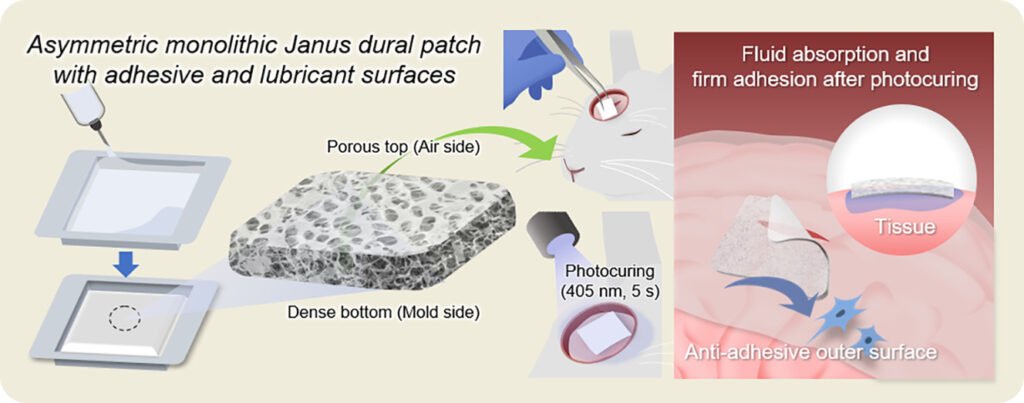
Researchers at Pusan National University have developed a light activated tissue adhesive patch designed to rapidly and securely seal tears in the dura mater, the protective membrane surrounding the brain and spinal cord. Dural tears, whether accidental or intentional during neurosurgery, can lead to cerebrospinal fluid leakage that increases the risk of headaches, delayed healing, and serious infections. Existing sealants and suturing techniques often struggle to provide a reliable watertight closure and can swell excessively, compressing nearby brain tissue or causing unwanted adhesions. The new patch aims to solve these problems by combining strong, controllable adhesion with minimal swelling and high biocompatibility.
The team created a Janus patch with two distinct sides that work together to achieve effective sealing. One side is engineered for strong adhesion to the dura when activated by light, while the other side is optimized for high fluid absorption with minimal volume change. This design allows the patch to quickly stop cerebrospinal fluid leakage without exerting harmful pressure on surrounding tissue. When exposed to light of a specific wavelength, the adhesive components crosslink and bond firmly to the tissue surface, giving surgeons precise temporal control over when and where the patch adheres. Laboratory tests showed that the patch can achieve rapid, watertight sealing of dural defects and maintain integrity under physiologically relevant pressures.
Biocompatibility was a central focus of the work. The researchers report that the materials used in the patch caused minimal inflammatory response and showed good integration with surrounding tissue in preclinical evaluations. Because the patch swells very little after application, it reduces the risk of mass effect, a common concern with many existing glue based sealants that can expand significantly after absorbing fluid. The study suggests that this light activated Janus patch could offer neurosurgeons a faster, more reliable, and safer option for dural closure compared with conventional sutures or bulk adhesives. The authors also note that the underlying design concept may be adaptable to other surgical fields where rapid, watertight, and tissue friendly sealing is critical, extending its potential impact beyond neurosurgery.
Article from Pusan National University: Developing Light-Activated Tissue Adhesive Patch for Rapid, Watertight Neurosurgical Sealing
Abstract in Chemical Engineering Journal: A monolithic Janus dural sealant with adhesive and lubricant surfaces activated by non-toxic visible light exposure
