
A research team at King Abdullah University of Science & Technology (KAUST) has developed a fingernail‑sized sensor that can instantly detect hazardous head impacts, offering a potential breakthrough for safety in sports, transportation, and other high‑risk environments. The project carries a personal motivation: one of the researchers lost his brother to an undetected head injury, which inspired the development of a device that can distinguish minor bumps from dangerous blows the moment they occur.
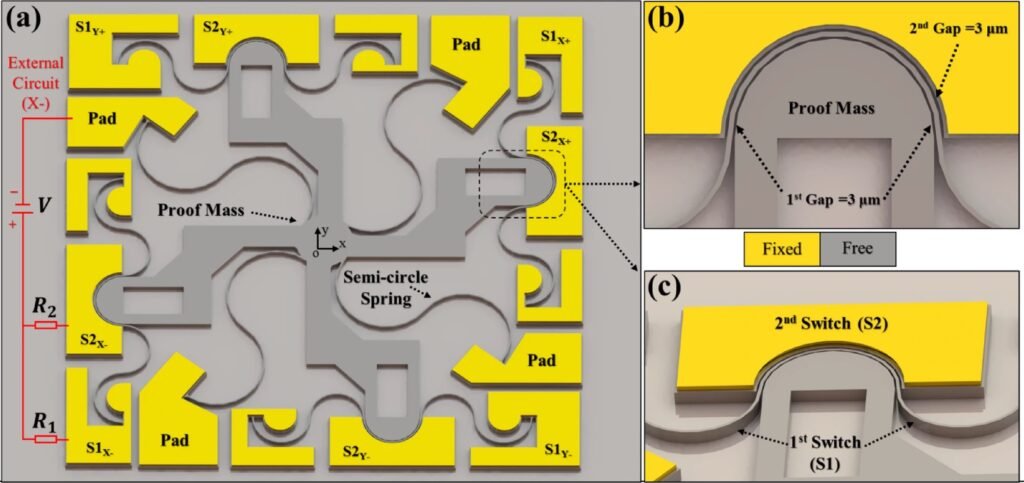
The sensor acts like a mechanical safety switch that responds to sudden acceleration. When a strong impact occurs, the internal structures make physical contact, closing an electrical circuit and activating the device. This design allows the sensor to gauge the severity of a hit in real time and from any direction. Because it draws no power while in standby mode, it remains energy efficient and ready to activate only when needed.
Roughly the size of a small fingernail, the sensor can be attached to a wide range of protective gear, including football helmets, ski goggles, industrial hard hats, and children’s headbands. Its compact form factor makes it suitable for both professional and everyday settings, where early detection of dangerous impacts could significantly reduce the risk of undiagnosed head trauma. The device’s ability to activate instantly is especially important because many serious head injuries go unnoticed at the moment they occur, delaying treatment and increasing the likelihood of long‑term harm.
The research team emphasizes that the sensor is designed to provide immediate, objective information about impact severity. This could help coaches, parents, workers, and medical professionals make faster decisions about whether someone needs medical evaluation. In sports, for example, athletes often continue playing after a hard hit because symptoms may not appear right away. A sensor that signals a dangerous impact could prompt earlier intervention and reduce the risk of secondary injuries.
Article from KAUST: Tiny sensor could transform head injury detection
Abstract in Scientific Reports: A 2D omnidirectional inertial switch with multiple thresholds
