
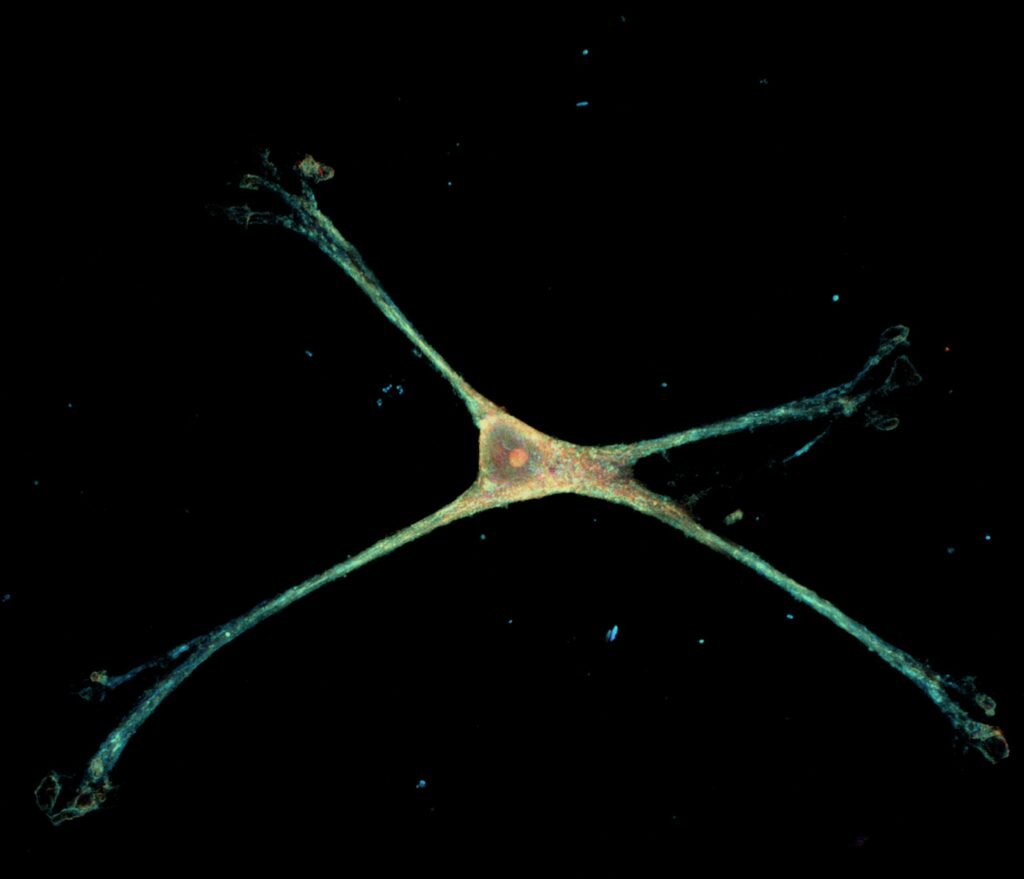
Astrocytes are star‑shaped support cells that make up much of the brain’s structure, helping neurons communicate and maintaining the blood‑brain barrier. They are essential for healthy brain function, but scientists have struggled to study them because astrocytes lose their distinctive branching shapes when grown on flat glass dishes. Without their natural form, it has been difficult to understand how they behave or how they contribute to diseases such as Alzheimer’s and Parkinson’s.
Researchers at Johns Hopkins University, working with colleagues in Italy, have solved this problem by creating mats of nanowires made from glass. These mats mimic the texture of brain tissue while remaining transparent for imaging. When astrocytes are grown on this surface, they regain their natural star‑like morphology, branching and maturing just as they do inside the brain. This breakthrough means scientists can now study astrocytes in conditions that closely match their real environment.
The team paired the nanowire mats with advanced imaging technology that provides high‑resolution, three‑dimensional views without the need for fluorescent tags or invasive staining. This combination allows researchers to watch astrocytes grow, branch, and change shape in detail, and to measure their structures precisely. Graduate student Anoushka Gupta explained that this approach finally makes it possible to quantify astrocyte morphology with accuracy, something that was not achievable before.
Astrocytes are linked to many neurological disorders, and their malfunction is thought to play a role in neurodegeneration. By recreating their natural environment, scientists can now explore how these cells behave in health and disease. The work also lays the foundation for “brain on a chip” technologies, where realistic cell cultures are used to model brain function, test drugs, and study injuries. Co‑senior author Ishan Barman described the advance as a leap beyond flat culture models, paving the way for next‑generation neuroengineering platforms.
Article from Johns Hopkins: Here’s a version with unnecessary capital letters removed while keeping standard title case: Nanowire Breakthrough Reveals Brain’s Unsung Heroes in Their Natural Habitat
Abstract in Advanced Science: Disordered Glass Nanowire Substrates Produce in Vivo-Like Astrocyte Morphology Revealed by Low-Coherence Holotomography
