
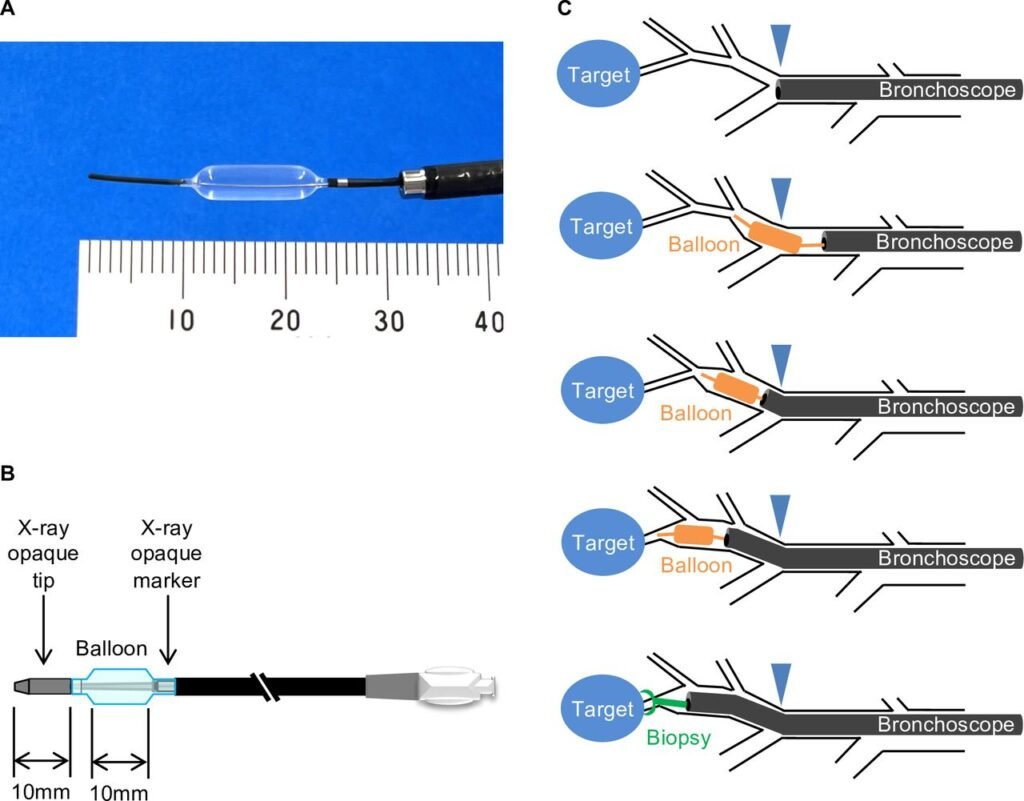
Lung cancer remains one of the most difficult cancers to diagnose early, largely because tumors often form in the peripheral regions of the lung where conventional bronchoscopes cannot reach. While CT scans can detect small lesions, obtaining a biopsy or delivering treatment has been a major challenge. The bronchi become narrower and more complex toward the periphery, forcing clinicians to stop several centimeters short of the target. This limitation has hindered both accurate diagnosis and minimally invasive treatment options. A new technique developed at Osaka University offers a solution by using balloon-assisted bronchoscopy to safely widen the airway and create access to these hard-to-reach areas.
The method, called Balloon-Assisted Bronchoscope Delivery, represents a paradigm shift in pulmonary medicine. Instead of attempting to design thinner and more flexible scopes, the researchers engineered a way to gently dilate the bronchial pathway. A thin catheter with a small balloon is advanced to the point where the airway narrows. Once in position, the balloon is inflated, expanding the bronchus just enough to allow the bronchoscope to move deeper toward the lesion. This simple yet effective approach enables clinicians to reach tumors that were previously inaccessible.
In a first-in-human clinical trial, the Osaka University team demonstrated that the technique is both safe and effective. Patients with lesions smaller than 20 millimeters, which are typically unreachable with standard bronchoscopy, were successfully examined using this method. The balloon catheter imposes minimal burden on patients, and the procedure was shown to be well tolerated. By enabling direct access to peripheral lung fields, the technique dramatically improves the ability to diagnose small tumors at an earlier stage.
The implications extend beyond diagnosis. With reliable access to peripheral lesions, clinicians can envision future endoscopic therapies where tumors are treated in a minimally invasive manner without major surgery. This could reduce patient recovery times, lower risks associated with invasive procedures, and expand treatment options for individuals who might not be candidates for traditional surgery.
