
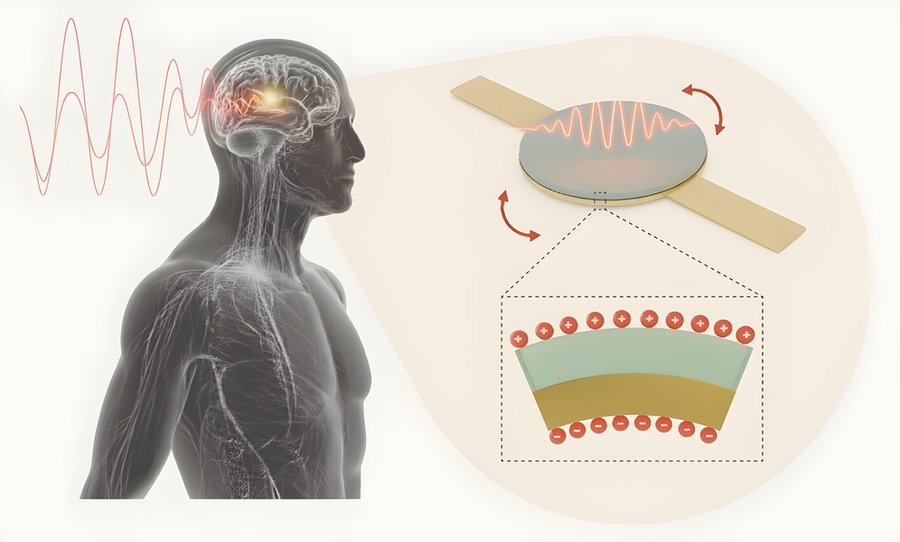
MIT researchers have unveiled a groundbreaking injectable antenna that could transform how medical implants are powered deep inside the human body. Traditional implants such as pacemakers or neuromodulators rely on bulky batteries or require invasive surgery for placement and maintenance. These approaches carry risks including infection, tissue damage, and repeated surgical interventions. The new antenna, developed by Associate Professor Deblina Sarkar and her group at the MIT Media Lab’s Nano-Cybernetic Biotrek, offers a safer and more efficient alternative by enabling battery-free implants that can be delivered through a simple injection.
The device is a magnetoelectric antenna smaller than a grain of sand, measuring less than half a millimeter. It can be inserted into tissue using a standard hypodermic needle, making the procedure minimally invasive. Once inside the body, the antenna harvests energy from low-frequency external magnetic fields, converting them into electrical power that can sustain implants located deep within tissues. This design avoids the heating risks associated with conventional wireless power systems, ensuring safety for long-term use.
The antenna’s magnetoelectric structure is key to its performance. It combines magnetic and electric properties to efficiently convert external magnetic fields into usable electrical energy. Because it operates at safe frequencies and is visible under imaging, clinicians can monitor and control the device without causing harm to surrounding tissue. The team demonstrated that the antenna can deliver sufficient energy to power devices such as pacemakers, neuromodulators for epilepsy or Parkinson’s disease, and biosensors for continuous monitoring.
The research was published in October 2025 in IEEE Transactions on Antennas and Propagation. Lead author Yubin Cai, along with collaborators including Baju Joy, showed that the antenna could be safely injected and controlled externally. Their experiments confirmed that the device maintained biocompatibility and avoided harmful heating effects, making it suitable for long-term implantation. The antenna’s small size and efficiency represent a major step forward in miniaturizing deep-tissue implants.
The clinical implications are significant. For cardiac patients, injectable antennas could power pacemakers without the need for surgical battery replacements. For neurological disorders, they could sustain neuromodulators that help manage conditions such as epilepsy or Parkinson’s disease. For broader health monitoring, they could enable biosensors that continuously track vital metrics deep inside the body, providing clinicians with real-time data without invasive procedures. These applications highlight how the technology could revolutionize patient care across multiple fields of medicine.
